The Role of World Agroforestry (ICRAF) in Promoting Bamboo for Climate-Resilient Forest Restoration in Kenya
Introduction: Why Bamboo Reforestation in Kenya Matters Now More Than Ever
Kenya is facing one of the most urgent environmental challenges of the 21st century—land degradation, deforestation, and climate change-induced ecosystem stress. Forest cover loss has reduced water catchment stability, increased soil erosion, and weakened rural livelihoods that depend on agriculture and forestry.
In response, bamboo reforestation in Kenya has emerged as one of the most promising nature-based solutions for restoring degraded landscapes. Bamboo is fast-growing, highly adaptive, and capable of restoring soil health, sequestering carbon, and stabilizing riverbanks and steep slopes.
At the center of scientific innovation in this transformation is the World Agroforestry (ICRAF)—a globally recognized research institution headquartered in Nairobi. ICRAF has been instrumental in advancing agroforestry systems that integrate trees, crops, and climate-smart land use practices for resilience and sustainability.
Alongside scientific research, practical implementation requires access to quality planting materials. This is where Seedlink (www.seedlink.co.ke | 0740712579) plays a crucial role, providing reliable bamboo seedlings and agroforestry planting materials for farmers, organizations, and restoration programs across Kenya.
What is World Agroforestry (ICRAF)?
The World Agroforestry (ICRAF) is a leading scientific institution under the CGIAR research network that focuses on the integration of trees into agricultural landscapes. Based in Nairobi, Kenya, ICRAF generates research-based solutions that improve food security, climate resilience, biodiversity conservation, and land restoration across tropical regions.
ICRAF’s core mission is to:
- Promote sustainable land use systems involving trees and crops
- Enhance climate resilience in farming systems
- Restore degraded landscapes using agroforestry models
- Support smallholder farmers through science-based innovations
ICRAF recognizes that trees—including bamboo—are essential tools for addressing climate change and land degradation in Africa.
Why Bamboo is a Game-Changer for Climate-Resilient Restoration
Bamboo is increasingly recognized by researchers, including those working with agroforestry systems, as a high-performance ecological restoration species.
1. Rapid Growth and Fast Land Recovery
Bamboo grows significantly faster than traditional timber trees. Some species can grow several feet in a single day, making it ideal for quickly restoring degraded land.
2. Carbon Sequestration Powerhouse
Bamboo is highly efficient at absorbing carbon dioxide, making it a powerful tool in climate change mitigation strategies.
3. Soil Stabilization and Erosion Control
Its dense root systems help:
- Stabilize riverbanks
- Prevent landslides
- Rehabilitate degraded hillsides
4. Water Catchment Protection
Bamboo plantations improve:
- Water retention in soil
- Groundwater recharge
- River flow stability
5. Economic Value for Communities
Bamboo supports multiple value chains:
- Construction materials
- Furniture production
- Crafts and biomass energy
- Eco-enterprises
This combination of ecological and economic benefits makes bamboo a central species in bamboo reforestation in Kenya initiatives.
The Role of ICRAF in Promoting Bamboo-Based Agroforestry
ICRAF has played a transformative role in integrating bamboo into broader agroforestry systems across Africa.
1. Research on Climate-Smart Landscapes
ICRAF studies demonstrate that integrating bamboo into degraded landscapes enhances:
- Soil fertility
- Biodiversity recovery
- Climate resilience
2. Bamboo in Watershed Restoration
Research findings show bamboo is particularly effective in:
- River basin rehabilitation
- Wetland restoration
- Dryland recovery systems
3. Policy Influence and Government Support
ICRAF collaborates with governments and institutions to:
- Develop agroforestry policies
- Promote land restoration programs
- Integrate bamboo into national climate strategies
4. Farmer Capacity Building
Through training programs, farmers are taught:
- How to propagate bamboo
- Sustainable harvesting techniques
- Agroforestry integration models
ICRAF’s work ensures bamboo is not just planted, but strategically integrated into sustainable land-use systems.
Bamboo Reforestation in Kenya: Key Regions of Impact
Bamboo reforestation efforts are particularly impactful in Kenya’s environmentally sensitive areas:
1. Central Highlands
- Aberdare ranges
- Mount Kenya region
These areas benefit from bamboo’s water regulation capacity.
2. Rift Valley Escarpments
- Soil erosion control
- Landslide prevention
3. Lake Victoria Basin
- Wetland restoration
- Riverbank stabilization
4. Eastern Drylands
- Wind erosion control
- Climate adaptation for arid zones
These regions represent high-priority zones for scaling bamboo reforestation in Kenya.
Seedlink: The Leading Supplier of Bamboo Seedlings in Kenya
Successful bamboo reforestation depends not only on research but also on access to high-quality planting materials.
This is where Seedlink (www.seedlink.co.ke | 0740712579) stands out as a trusted partner.
Why Seedlink is the Best Choice for Bamboo Seedlings
Seedlink provides:
- Certified bamboo seedlings for various ecological zones
- High germination and survival rates
- Expert guidance on planting and maintenance
- Nationwide supply for restoration projects
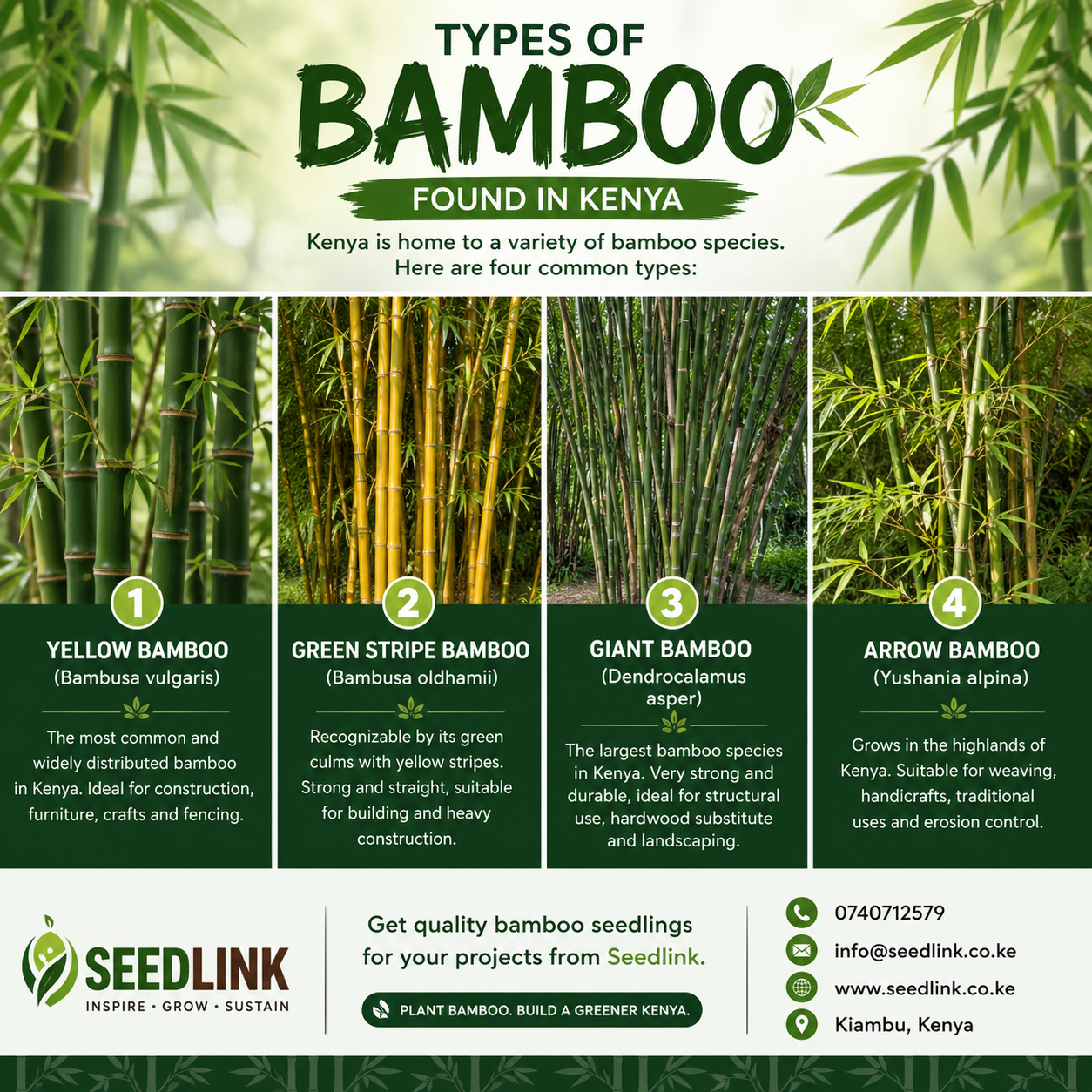
Bamboo Varieties Available at Seedlink
- Giant Bamboo species for construction and timber use
- Clumping bamboo for ecological restoration
- Fast-growing varieties for erosion control
- Agroforestry-compatible bamboo types
Who Uses Seedlink Bamboo Seedlings?
- Farmers engaged in agroforestry
- County governments
- NGOs and environmental organizations
- Schools and community groups
- Commercial tree planting projects
Seedlink plays a key role in scaling bamboo reforestation in Kenya from research to real-world implementation.
📞 Contact Seedlink: 0740712579
🌐 Website:
www.seedlink.co.ke
How Bamboo Supports Climate-Resilient Forest Restoration
Climate-resilient restoration focuses on rebuilding ecosystems that can withstand drought, floods, and temperature extremes.
Bamboo contributes in several ways:
1. Restoring Degraded Land Quickly
Its rapid growth allows landscapes to recover faster than traditional tree species.
2. Supporting Biodiversity
Bamboo ecosystems support:
- Birds
- Small mammals
- Insects and pollinators
3. Strengthening Agroforestry Systems
Bamboo can be intercropped with:
- Coffee
- Tea
- Food crops
- Fruit trees
4. Supporting Circular Bioeconomy
Bamboo products replace:
- Plastic materials
- Non-renewable timber
- High-carbon construction inputs
This aligns with Kenya’s climate adaptation and green growth agenda.
ICRAF and the Future of Bamboo in Kenya’s Green Economy
The future of bamboo in Kenya is closely linked to the expansion of agroforestry systems supported by institutions like ICRAF.
Key future opportunities include:
- Bamboo-based carbon credit programs
- Industrial bamboo processing hubs
- Green construction materials
- Rural employment through bamboo value chains
ICRAF’s continued research ensures that bamboo is not just planted, but fully integrated into Kenya’s climate and economic systems.
Challenges in Bamboo Reforestation in Kenya
Despite its potential, bamboo reforestation faces challenges:
1. Limited Access to Quality Seedlings
Many farmers struggle to find certified bamboo planting materials.
2. Lack of Awareness
Some communities still underestimate bamboo’s ecological value.
3. Policy Gaps
More integration is needed in national forestry and land restoration policies.
4. Value Chain Development
Industrial processing of bamboo is still emerging.
These gaps highlight the importance of partners like Seedlink in bridging the implementation divide.
Conclusion: Scaling Bamboo Reforestation in Kenya Through Science and Innovation
Bamboo is no longer just a plant—it is a climate solution, an economic resource, and a land restoration tool.
The World Agroforestry (ICRAF) continues to lead research and policy development that positions bamboo as a cornerstone of climate-resilient landscapes in Kenya and beyond.
However, successful implementation depends on access to quality planting materials, technical support, and strong private-sector participation.
This is why Seedlink (www.seedlink.co.ke | 0740712579) plays a vital role in driving bamboo reforestation in Kenya, ensuring farmers, institutions, and environmental programs can access the right bamboo varieties for restoration success.
Together, science (ICRAF) and implementation partners (Seedlink) are shaping the future of climate-resilient forest restoration in Kenya.